

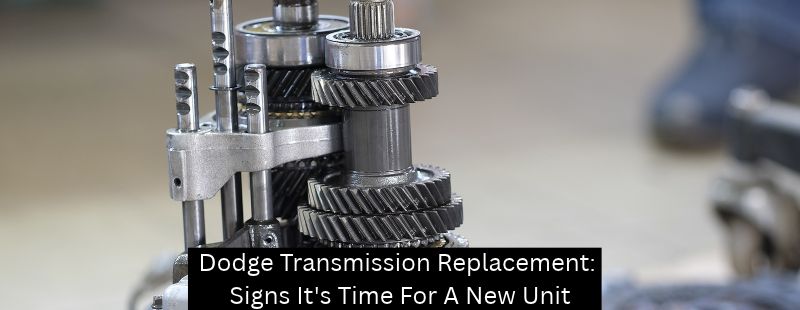
It is time to consider a new transmission for your Dodge when you see severe slipping in multiple gears, no movement in drive or reverse, metal debris in the fluid, persistent grinding noises, or repeated failures after earlier repairs. These signs usually point to internal damage that a repair cannot reliably correct. Here is how to recognize them and what to do next.
Many Dodge transmission problems can be repaired. A worn solenoid, a leaking seal, a faulty sensor, or degraded fluid can often be corrected without replacing the whole unit. A responsible technician always considers those options first. Replacement enters the conversation when the damage goes deeper than a repair can fix.
Dodge vehicles often work hard. Ram trucks tow, Durangos and Grand Caravans carry families and cargo, and Chargers and Challengers are driven with enthusiasm. That workload can lead to heat and wear, and over time, some transmissions reach the end of their service life.
If the engine revs high and the vehicle barely accelerates, in more than one gear, the clutch packs are likely badly worn.
A vehicle that will not move after you select a gear may have suffered an internal failure. A diagnosis will confirm whether the issue is major or something simpler.
Visible metal flakes, glittery fluid, or thick, burnt-smelling fluid indicate serious wear or overheating inside the unit.
Grinding that continues across different speeds or gears is a sign that major components, such as gears or bearings, may be damaged.
Occasional limp mode can be a sensor or software issue. Limp mode that returns repeatedly, together with other symptoms, can point to deeper problems.
When the same symptoms keep returning, the original damage may be more extensive than it first appeared.
Ultimately, the clearest sign is a professional diagnosis that shows the transmission cannot be repaired reliably.
Most of these are preventable. That is why early attention is so valuable.
Winter is hard on a transmission. Cold thickens the fluid and stiffens seals, so a worn unit gets less lubrication on cold starts and faces higher shift loads. Many Dodge owners plow driveways, pull snowmobile trailers, or drive on snow and ice, and rocking a vehicle out of a drift is especially hard on weakened parts. Road salt can also speed up leaks and corrosion.
A transmission that was barely holding on in autumn can fail completely in the deep cold of winter, often far from home and often in dangerous weather. If your Dodge has been showing serious warning signs, do not wait for the first deep freeze or a holiday road trip to expose them. A planned replacement before winter is far easier to manage than a breakdown in the middle of a snowstorm.
A good shop explains these clearly and recommends what fits your vehicle and how you use it.
Get a proper diagnosis. A thorough inspection includes a road test, fault-code scan, fluid inspection, leak check, and, if needed, an internal inspection. If the news is a major repair or replacement, it is reasonable to ask the technician to show you what they found.
Mister Transmission has been a transmission specialist since 1963. Every visit starts with a free Road Test and Multi-Check, backed by advanced diagnostic technology, so recommendations are based on what is really happening in your vehicle.
A new or remanufactured transmission is a fresh start, and a few good habits help it last. The best results come from treating the first weeks with care and keeping up with maintenance afterward:
Winter adds a few more points. Let the vehicle warm up gently on cold mornings, and never rock it back and forth between drive and reverse to escape a snowbank for long periods, since that builds heat quickly. If you plow driveways or pull a snowmobile trailer with your Dodge, stay within the rated towing limits. Treating the new transmission well in its first winter pays off for years.
Often, yes, especially when caught early. Replacement is for damage that cannot be repaired reliably.
A fine film can be normal wear, but visible flakes or chunks point to internal damage and should be inspected promptly.
No. Have it inspected before attempting further driving.
That depends on the unit, the way you drive, and how well it is maintained. Regular fluid service, sensible towing, and prompt attention to warning signs all help it last longer.
Follow the schedule and advice the shop gives you. Your technician can tell you when the first service should happen and what fluid your Dodge needs.
A clear diagnosis gives you control over the decision. If your Dodge is showing serious transmission trouble, book a free Road Test and Multi-Check at Mister Transmission by calling 800-373-8432, and get the full picture before you decide what comes next. Cold weather and holiday travel are close, and a worn transmission rarely gets better on its own. Acting now gives you time to compare repair and replacement options, ask questions, and plan around your schedule instead of reacting to a breakdown on a snowy road. Whatever the diagnosis shows, you will know exactly where your Dodge stands, what it needs, and which steps can safely wait until later.



The evolution of transmissions has made these machines and systems increasingly complex. When transmission repairs are required, determining the cause and cure for what ails can be tricky.
Read More
At Mister Transmission we have access to leading-edge diagnostic equipment, enabling us to offer you the fastest and most accurate findings about what’s going on inside your vehicle’s transmission.
Read More
Just as you have other parts of your car serviced, your transmission needs maintenance to ensure a long life and avoid transmission problems.
Read More