

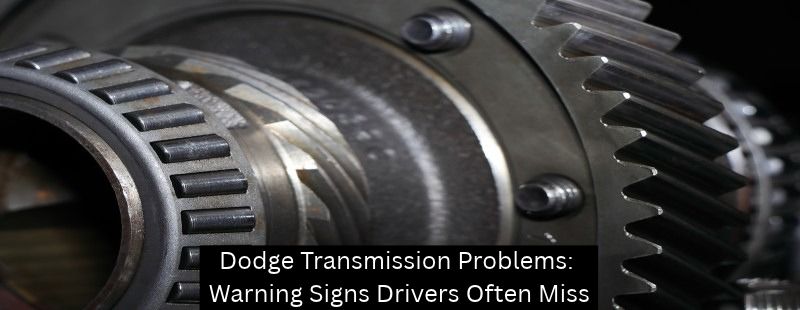
The warning signs Dodge drivers most often miss are a slight delay when shifting into drive, a faint whine or hum, a small shudder at certain speeds, occasional flaring between gears, and a quiet drip of fluid on the driveway. They are easy to dismiss, but they usually appear weeks or months before a serious failure. Here is how to spot them early and what to do next.
Transmission trouble rarely announces itself with a dramatic breakdown. It creeps in. A shift that feels a little firmer, a pause that was not there last month, or a noise you only hear on quiet streets all feel like quirks of an aging vehicle. Because the change is gradual, drivers get used to it.
Dodge vehicles also span a lot of ground, from the Charger and Challenger to the Durango, Journey, Grand Caravan, and Ram trucks. Many of these vehicles carry passengers, cargo, or a trailer, so the transmission is often under a heavier load than the driver realizes. That makes small signs more important, not less.
If the vehicle hesitates for a second before it engages, that is delayed engagement. It is a classic early sign of low fluid pressure, worn internal parts, or degraded fluid.
A brief surge in engine revs between gears, especially on the highway, can be easy to write off as a one-time event. If it happens more than once, the transmission is telling you something.
Some Dodge vehicles lock into a single gear when the transmission control system detects a fault. The vehicle still drives, but it is sluggish and will not shift normally. This protective mode is a warning to have the vehicle checked soon, not a sign it has fixed itself when it clears.
A new noise that changes with speed or gear can point to low fluid or internal wear. Noises are among the first signals a transmission gives, and among the most ignored.
A light vibration around highway speed can come from fluid that has broken down, or from a torque converter that is not locking up smoothly.
A few drops of red or reddish-brown fluid on the driveway are easy to overlook, but even a small leak lets fluid levels fall over time. Low fluid is a leading cause of transmission damage.
In September, drivers tend to relax. The summer rush is over, the weather is pleasant, and a slow shift or faint hum is easy to blame on the changing temperatures. Cooler mornings do thicken the fluid slightly, so a brief hesitation on a cold start can be normal. The real warning sign is a symptom that stays after the vehicle has warmed up, or one that keeps getting worse week after week.
This is also a month when vehicles are put through a lot. Rams and Durangos tow boats, seadoos, and campers to storage, Grand Caravans handle school runs, and long weekends bring one last cottage trip. Summer heat may have already worn the fluid, and cooler weather can expose a weak transmission. Take a few minutes to notice how your Dodge shifts once it is warm, and get it checked if anything feels off.
Do not wait for the problem to get louder. Get a proper diagnosis. Write down when you notice the symptom, such as cold start, highway speed, or while towing. If the vehicle goes into limp mode or the warning light comes on, avoid towing and long trips until a technician has looked at it.
A small sign can have a simple cause or a serious one. Without the right tools, it is easy to guess wrong. Mister Transmission offers a free Road Test and Multi-Check, backed by advanced diagnostic technology, so technicians can read the codes, check the fluid, and confirm exactly what your Dodge is doing before any work begins.
The drivers who avoid big transmission problems are rarely the ones with special tools. They are the ones who notice small changes and write them down. A few simple habits go a long way:
These notes are valuable at the shop. A technician who hears “it hesitates when cold, only in the first few minutes, and only after the weekend trailer trips” has a head start on the diagnosis. Early fall, when the weather is mild and schedules are open, is the ideal time to build these habits and have anything unusual looked at.
It is a protective setting that limits shifting when the vehicle detects a fault. It should be checked promptly, even if the vehicle seems to drive normally afterward.
It can be. Even a slow leak lowers fluid levels over time, and low fluid is a leading cause of transmission damage.
No. Towing adds heat and load. Get the transmission checked before towing.
Cold thickens transmission fluid, which can make shifts feel firmer for the first few minutes. If it continues after the vehicle is warm, or gets worse over time, it deserves a proper inspection.
Yes. The transmission is monitored electronically, and a detected fault can set a code that triggers the check engine light or a transmission warning. A scan will show what the vehicle has recorded.
The drivers who spot the small signs spend far less time and effort than the ones who wait. If your Dodge is hesitating, humming, shuddering, or dripping, find your nearest Mister Transmission location or call 800-373-8432 for a free Road Test and Multi-Check, and get a clear answer before the problem grows.



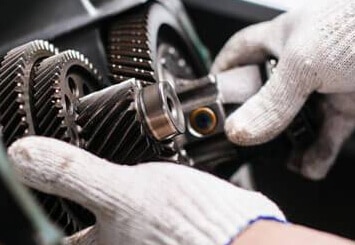
The evolution of transmissions has made these machines and systems increasingly complex. When transmission repairs are required, determining the cause and cure for what ails can be tricky.
Read More
At Mister Transmission we have access to leading-edge diagnostic equipment, enabling us to offer you the fastest and most accurate findings about what’s going on inside your vehicle’s transmission.
Read More
Just as you have other parts of your car serviced, your transmission needs maintenance to ensure a long life and avoid transmission problems.
Read More