

Most drivers don’t think about their transmission until something goes wrong. That’s understandable — it’s not a system that demands daily attention. But when symptoms appear, the path forward isn’t always obvious. What does a transmission shop actually do? What’s the difference between a service, a repair, and a full overhaul? And how do you know which one your Ford actually needs?
These questions create real uncertainty for vehicle owners across Canada — from drivers in Ontario dealing with heavy city traffic wear to those in Saskatchewan and Manitoba putting serious highway kilometres on their trucks. The answers matter because the decisions that follow directly affect your vehicle’s long-term reliability and the cost you’ll absorb.
A transmission inspection is the starting point for every service decision. It’s not a quick visual check — it’s a structured evaluation combining physical assessment, fluid analysis, road testing, and electronic diagnostics.
At Mister Transmission, the process begins with a free road test and multi-check. A technician drives the vehicle to observe real shifting behaviour under load, then brings it in for a lift inspection to check for fluid leaks, seal condition, and visible mechanical issues.
Modern Ford transmissions are computer-controlled systems. The transmission control module logs fault codes every time the system detects something outside its normal operating range. Reading those codes accurately requires specialized diagnostic equipment — not a generic code reader.
Mister Transmission uses leading-edge diagnostic technology to access transmission-specific data, including solenoid performance, shift timing, fluid temperature patterns, and sensor readings. This is often where the real story of what’s happening inside the unit becomes clear.
The inspection outcome dictates which service path is appropriate. A vehicle that feels like it needs a full replacement sometimes only requires a solenoid swap or a fluid service. Skipping a thorough inspection — or relying on a shop without transmission-specific diagnostic capability — is where misdiagnosis and unnecessary costs follow.
Transmission fluid service is the most fundamental maintenance a Ford owner can schedule, and it’s frequently the most overlooked.
Fluid does several jobs simultaneously: it lubricates moving parts, transfers hydraulic pressure to activate gear changes, and dissipates heat. Over time it breaks down, protective additives degrade, and its ability to maintain consistent pressure drops.
For Ford vehicles that tow, operate in stop-and-go traffic in cities like Toronto or Vancouver, or face cold-climate conditions across Alberta, fluid degradation happens faster than standard service intervals suggest.
A proper fluid service involves draining the old fluid, inspecting it for metal particles or burnt odour, and refilling with the correct specification for the specific Ford transmission. Some services include a pan inspection and filter replacement. Done consistently, this work extends transmission life and prevents the internal wear that leads to more expensive intervention later.
Not every Ford transmission problem requires the unit to be removed. Many common issues are resolved through targeted repairs while the transmission remains in place.
These include solenoid pack replacements for electronic shifting faults, sensor replacements for erratic shifting behaviour, and reseal work to stop external fluid leaks at gaskets and seals.
If your Ford has an external fluid leak but the transmission is otherwise functioning correctly, a reseal is often all that’s required. A technician identifies exactly where the leak originates and replaces the affected seals or gaskets — most of which are accessible without removing the unit.
The front seal is an exception. Accessing it requires the transmission to come out first. Mister Transmission’s technicians assess this clearly during inspection and explain exactly what’s involved before any work begins.
A complete transmission overhaul — also called a rebuild — is the right call when internal wear is widespread, when multiple components have failed, or when the transmission has been running on degraded fluid for an extended period.
The transmission is fully removed and disassembled. Every internal component is inspected — gears, clutch packs, bands, seals, gaskets, the valve body, and the torque converter. Worn or damaged parts are replaced. Friction components like clutches and bands are replaced as standard practice during a rebuild, regardless of apparent condition, because they’re consumable items that affect long-term reliability.
The torque converter is typically replaced with a remanufactured unit. All seals and gaskets are replaced as a matter of course.
Mister Transmission’s technicians also review technical service bulletins specific to the Ford transmission being serviced. These bulletins document manufacturer-identified design improvements and upgrade kits addressing known issues in the original build. Incorporating these updates during a rebuild is what separates a proper overhaul from simply reassembling the unit as it came apart.
When a transmission reaches overhaul stage, some owners ask about replacing the unit entirely. Not all alternatives are equal.
A used transmission carries an unknown service history and may have experienced the same wear patterns as the unit being replaced. It’s often a false economy. A remanufactured unit is rebuilt to factory specifications and is a legitimate option Mister Transmission can discuss based on your specific Ford model.
The rebuild route — removing your existing transmission, overhauling it, and reinstalling it — gives technicians full visibility into what failed and confirmation that every component is in correct condition before the vehicle goes back on the road.
| Service Type | What to Know |
| Inspection & Road Test | Starting point for all decisions — includes electronic diagnostics and fluid review |
| Fluid Service | Preventative maintenance that extends transmission life and protects internal components |
| In-Car Repairs | Solenoid, sensor, and seal work completed without removing the transmission |
| Reseal Job | Addresses external fluid leaks at gaskets and seals — most done in-car |
| Complete Overhaul / Rebuild | Full disassembly, inspection, and component replacement including TSB updates |
| Remanufactured Unit Replacement | Alternative to rebuilding — appropriate in select cases based on diagnostic findings |
A transmission service refers to preventative maintenance — fluid changes, filter replacement, and inspection. A repair addresses a specific mechanical or electronic fault affecting performance. They’re not interchangeable. Many drivers come in expecting a repair and leave with a service recommendation because the problem is caught early enough that maintenance is all that’s needed.
A complete overhaul typically takes several days, depending on parts availability for the specific Ford model. After reinstallation, the vehicle is tested to confirm correct shifting and proper communication between the transmission and engine control systems. Mister Transmission works to minimize turnaround time without cutting corners on post-installation verification.
That determination requires a proper diagnostic inspection. Symptoms don’t always map directly to the scope of repair needed. A technician uses road test results, fault code data, and physical inspection findings together to make an accurate call. Assuming a rebuild is needed — or assuming it’s just a minor fix — often leads to either overspending or under repairing.
Understanding what a Ford transmission shop actually does — and what each service level involves — puts you in a better position when something goes wrong. The process starts with an honest inspection, identifies exactly what’s needed, and proceeds with the right level of intervention.
Mister Transmission has been providing transmission expertise to Canadian drivers since 1963, with locations operating coast to coast. Whether your Ford needs a routine fluid service, a targeted in-car repair, or a complete overhaul, the diagnostic-first approach at Mister Transmission ensures the work recommended is the work actually required. Find your nearest location and book your free road test and multi-check.



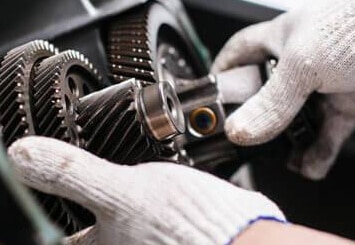
The evolution of transmissions has made these machines and systems increasingly complex. When transmission repairs are required, determining the cause and cure for what ails can be tricky.
Read More
At Mister Transmission we have access to leading-edge diagnostic equipment, enabling us to offer you the fastest and most accurate findings about what’s going on inside your vehicle’s transmission.
Read More
Just as you have other parts of your car serviced, your transmission needs maintenance to ensure a long life and avoid transmission problems.
Read More