

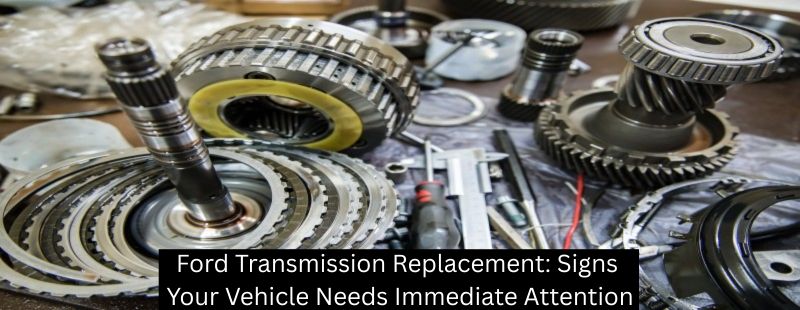
Ford vehicles are built to handle demanding conditions — from city commutes in Ontario to long highway stretches across Alberta and British Columbia. But even the most well-engineered drivetrain has its limits, and the transmission is almost always the first major system to signal distress before anything fully breaks down.
Transmission problems in Ford vehicles rarely announce themselves all at once. They develop gradually — a subtle shudder here, a delayed gear shift there — and drivers often dismiss these as minor quirks. By the time the issue becomes impossible to ignore, what could have been a straightforward repair has turned into a full replacement conversation.
Understanding what your Ford is telling you, and acting on it quickly, is what separates a manageable repair bill from a major mechanical event. This article walks through the specific signs that indicate your Ford’s transmission needs immediate professional attention, and what your options are when a replacement becomes the right call.
Ford produces a wide range of vehicles across its lineup, and the transmission systems in these vehicles — from 6-speed automatics to SelectShift units — are increasingly computerized and complex. That complexity improves performance, but it also means failure modes are harder to diagnose without the right equipment.
Transmission wear is rarely sudden. It’s cumulative. Heat, fluid degradation, and mechanical stress build up over time, especially in vehicles that tow regularly or operate in stop-and-go traffic. Drivers in cities like Toronto and Vancouver, where traffic density is high, often see transmission symptoms emerge earlier than expected.
The most important thing to understand: there’s almost always a window between the first symptom and a full failure. That window is your opportunity.
When you shift into Drive or Reverse and there’s a noticeable pause before the vehicle responds, that’s a sign the transmission isn’t engaging cleanly. You might also feel a hard clunk when the gear finally catches.
This is one of the earliest red flags, and it’s easy to rationalize away as a “cold morning” issue. It isn’t. Consistent engagement delay points to internal wear, solenoid problems, or deteriorating fluid pressure — all of which progress if ignored.
Gear slip feels like the transmission momentarily loses its grip on the engine. The RPMs spike without a corresponding increase in speed, or the vehicle suddenly feels like it’s in a lower gear than it should be.
In Ford automatics, this is often tied to clutch pack wear or hydraulic pressure loss. It’s a safety concern, not just a mechanical one — especially at highway speeds in areas like the Trans-Canada corridor.
Whining, humming, or clunking sounds that occur during gear changes aren’t normal. A healthy Ford transmission shifts smoothly and quietly. When you start hearing mechanical noise in the shift cycle, something inside the unit is either worn or making contact it shouldn’t be.
These sounds are often more noticeable at lower speeds and in parking lots, where engine noise is minimal.
Red or brown fluid spots under your vehicle are a direct signal that your transmission needs to be inspected. Transmission fluid is the lifeblood of the entire system — it lubricates, cools, and hydraulically actuates the unit. Running low on fluid accelerates internal damage at a significant rate.
A reseal job can often address external leaks before they escalate. But if fluid loss has been occurring for a while without being caught, internal damage may already be present.
Modern Ford vehicles use sophisticated control modules to manage transmission behavior. When a sensor detects something outside normal operating parameters, the check engine light or transmission warning indicator will trigger.
Erratic shifting — the transmission hunting between gears, shifting too early, or refusing to shift at all — is the system’s way of telling you the electronic and mechanical components are no longer working in sync.
Not every transmission problem requires a full replacement. The scope of the repair depends entirely on what the diagnostic reveals, and that’s why an accurate assessment is the critical first step.
Minor issues — solenoid faults, external leaks, sensor replacements, fluid services — are often handled without removing the transmission from the vehicle. These repairs are cost-effective and, when caught early, restore full function.
If internal components — clutch packs, bands, the torque converter, or the planetary gear set — have sustained significant wear or damage, a rebuild or replacement is typically the more sound long-term decision. Replacing only failed components inside a heavily worn unit often leads to recurring issues within a short period.
At Mister Transmission, the evaluation process determines exactly what level of intervention your Ford actually needs — not the most expensive option, the right one.
A proper Ford transmission replacement involves removing the existing unit, evaluating whether a rebuild, remanufactured unit, or direct replacement is appropriate, and reinstalling with full testing. Technical service bulletins are reviewed to ensure any manufacturer-known design updates are incorporated into the repair.
Mister Transmission’s technicians use leading-edge diagnostic equipment to read the vehicle’s control systems before and after the repair, confirming the transmission is communicating correctly with the engine and all related modules.
| Factor | What to Know |
| Delayed gear engagement | Often the first sign of hydraulic pressure loss or solenoid wear |
| Gear slipping | Points to clutch pack wear or low fluid — escalates quickly if ignored |
| Fluid leak | Red or brown fluid under the vehicle requires immediate inspection |
| Unusual shifting noises | Mechanical contact or wear inside the unit — not a normal operating sound |
| Warning light activation | Electronic fault codes require professional diagnostic scanning |
| Erratic shifting behavior | Transmission control module or sensor issue — can affect drivability and safety |
The only reliable way to determine this is through professional diagnostic testing. A technician will assess the condition of internal components, fluid integrity, and control system function. Many transmission issues that feel severe — like gear slipping or rough shifting — can be resolved with targeted repairs rather than a full replacement, depending on how early the problem is caught.
Transmission replacement costs vary based on the vehicle model, transmission type, and the extent of the damage. The diagnostic findings determine whether a rebuild, remanufactured unit, or direct replacement is most appropriate. Mister Transmission provides a clear breakdown of costs after assessment, and flexible payment options are available to help manage the expense.
Driving with a slipping transmission is not advisable. Gear slip indicates the transmission is failing to maintain consistent power transfer, which creates unpredictable behavior — particularly at highway speeds or during acceleration. Continuing to drive in this condition typically accelerates internal damage and raises the overall repair cost.
Ford transmissions are engineered to perform, but they do communicate when something’s wrong. The warning signs are almost always there before a failure becomes a crisis — delayed shifting, fluid leaks, unusual noises, and warning lights are all signals that deserve professional attention, not a wait-and-see approach.
Mister Transmission has been the name Canadians trust for transmission expertise since 1963, with locations operating coast to coast from British Columbia to Nova Scotia. Whether your Ford needs a targeted repair or a full replacement, the diagnostic process at Mister Transmission ensures the right solution is identified — not the most expensive one. Find your nearest location and book an assessment before a manageable problem becomes a major one.



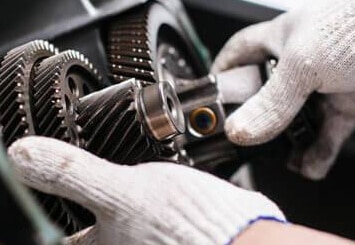
The evolution of transmissions has made these machines and systems increasingly complex. When transmission repairs are required, determining the cause and cure for what ails can be tricky.
Read More
At Mister Transmission we have access to leading-edge diagnostic equipment, enabling us to offer you the fastest and most accurate findings about what’s going on inside your vehicle’s transmission.
Read More
Just as you have other parts of your car serviced, your transmission needs maintenance to ensure a long life and avoid transmission problems.
Read More